

How to prevent your boat from sinking when moored
28 October 2026
A boat doesn’t have to be underway to get into trouble. It can take on water at its mooring between trips, too. In our 2025 claims figures, sinking claims cost around 148% more on average than other claims. A few checks before you leave can help you spot a leak or blocked drain before it becomes a bigger problem. Here’s what to look at on yachts, motorboats and narrowboats.
These are general suggestions to read alongside your boat and equipment manuals. A qualified marine professional can explain which checks or maintenance are appropriate for your boat.
Why can a boat sink while moored?
A leaking fitting can let water in below the waterline. Rainwater can collect when a drain is blocked. And if a boat gets caught at an angle as water levels change, water may find its way aboard. Being securely tied up won’t prevent all of these problems.
It helps to know where water should drain on your boat, which fittings pass through the hull and how the bilge pump gets its power when you’re away.
Check 1: Blocked cockpit and deck drains on moored boats
Leaves and dirt can gather around cockpit and deck drains between visits. It may be worth looking for anything blocking the openings, as even a small blockage can leave rainwater with nowhere to go.
The Canal & River Trust’s flood preparation guide explains how blocked drains can let water reach an engine compartment. On an inland boat, drainage around the engine area may be worth including in your checks.
Your boat’s manual may explain how to clean accessible drains and where they discharge. If an outlet looks damaged or a blockage is out of reach, a marine professional may be able to help. Required ventilation must stay open. Covering a vent to keep rain out isn’t a safe fix.
Check 2: Bilge pump operation and battery power while moored
The bilge pump removes water from the low spaces inside the hull. An automatic model uses a float switch or another sensor to detect water and switch itself on.
A pump test could form part of your checks before leaving, along with a look at the battery’s condition and charge. The equipment instructions should explain the tests for your model. If you’re unsure how the pump gets power while you’re away, a marine engineer could talk you through it.
For pumps with manual and automatic controls, it may be worth including both functions in any testing described by the manufacturer. Hearing the pump run when switched on by hand doesn’t confirm that it will start automatically.
A working pump still needs a clear inlet, and it can’t always keep up with a large leak. If yours starts running more often than usual, this could be a reason to ask a marine professional to investigate. A pump can help remove water, but it doesn’t repair the source of a leak.
Check 3: Potential leaks through boat hull fittings and seals
The places to check will depend on your boat. A yacht’s fittings won’t be the same as a narrowboat’s, and two similar boats may have different installations. Your boat’s manual or a marine professional could help you identify the areas worth including in a maintenance routine.
Potential leaks around hull fittings hoses and seacocks
Seacocks are valves fitted to openings through the hull for systems such as engine cooling, toilets and sink drainage.
Leaks, corrosion and deteriorating hoses around accessible fittings are all things you could look out for. A marine professional can assess anything that concerns you. Don’t dismantle fittings while afloat or force a valve that won’t move.
An engineer could help explain which valves to close when you leave and which need to stay open. Some systems may need to keep running while you’re away. A written note of what needs reopening before use could be useful to keep with the boat’s records. Required drains must stay clear.
Water ingress around stern glands and narrowboat weed hatches
On boats with a propeller shaft passing through the hull, the stern gland or shaft seal helps control water ingress around the shaft. The maintenance instructions for your type of seal are a useful starting point for understanding its upkeep.
Stern glands vary, so greasing or tightening may not be appropriate for every seal. A marine professional could explain what applies to yours.
If your narrowboat has a weed hatch, its fastening and seal may be worth including in your checks, using the boat’s instructions. The Canal & River Trust’s sinking prevention guide identifies an unsecured weed hatch as a serious water-entry hazard. A marine professional could help if you are unsure how the fastening works or the seal looks damaged.
Check 4: Mooring lines and snagging risks as water levels change
Your boat needs room to move as the water rises and falls. Lines that hold it too tightly can stop that movement, and a ledge or other obstruction can catch the hull.
Your marina or mooring operator may be able to explain changes in water level at your berth and anything the boat could snag on. The answer may be different from one mooring to the next.
Wear where lines rub is something you could look out for. A marine professional or mooring operator may be able to comment on their arrangement. The amount of slack another boat needs may not be right for yours.
Our guide to sailing knots explains common knots, but how you tie up will depend on the berth.
Check 5: Boat visits and contact arrangements while you are away
If someone is checking the boat while you’re away, it could help to agree what they’ll look at and how they’ll contact you. A nearby berth holder might notice the boat sitting lower in the water, for example, but they may not have access to test the pump.
Leaving contact details for the marina or mooring operator and your chosen marine professional could make it easier for someone to raise a concern. It may also help to discuss signs that need urgent attention, such as a boat leaning unexpectedly, water rising inside or a pump that won’t stop running.
There’s no set visiting schedule that suits every boat and berth. Heavy rain or a weather warning may be a reason to consider an extra visit, provided it’s safe to get there. Never walk onto a flooded pontoon to check the boat.
What if you find your moored boat taking on water?
Put people first. Do not board an unstable or partly submerged boat, enter a flooded compartment or attempt a hazardous recovery.
If anyone is in immediate danger, call 999 or 112 and give the exact location. For a coastal emergency, ask for the Coastguard. The RNLI’s emergency guidance explains how to call for help.
Alert the marina or mooring operator and follow the emergency instructions. Once people are safe, contact your insurer and the relevant navigation or harbour authority. Leave recovery work to specialists.
Suggested checks before leaving your boat moored
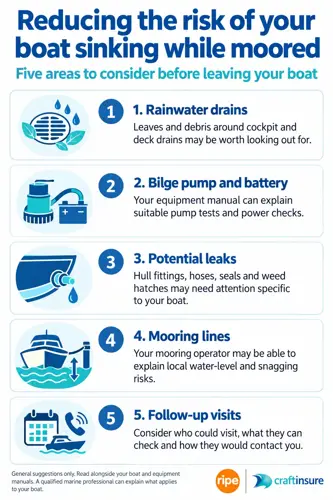
Depending on your boat and its maintenance instructions, the following may be useful to include in your checks:
-
Drains: leaves or debris around accessible openings.
-
Pump and power: the tests described in the equipment instructions, including automatic operation where fitted, and the battery’s condition and charge.
-
Water entry points: signs of leaks or damaged fittings that may need professional attention.
-
Mooring lines: suitability for the berth and expected water-level changes, with input from the mooring operator or a marine professional if needed.
-
Follow-up: arrangements for visits and a way to contact you if there’s a concern.
Questions about sinking risks and insurance for moored boats
Can heavy rain sink a moored boat?
Yes, rainwater can build up if the drains are blocked or the pump can’t keep up. Drainage and pump checks may help identify problems before you leave. The relevant checks will depend on your boat and its equipment instructions.
Will an automatic bilge pump stop my boat sinking?
It can help, but it won’t stop every sinking. The pump needs power, working automatic controls and correct installation. A leak can also let water in faster than the pump removes it. Unexplained water in the boat may be a reason to seek a marine professional’s help.
Should I close the seacocks before leaving my boat?
That depends on your boat and the systems connected to them. A marine professional could explain which valves to close, which to leave open and what to check before starting equipment again. The same position won’t suit every valve.
Does boat insurance cover sinking while moored?
Do not assume every sinking is covered. Check the wording for your boat, including the cause of damage, conditions and exclusions. Craftinsure’s important documents are organised by boat type. Ask about anything unclear before relying on cover.
Specialist boat insurance by Craftinsure
If you’re concerned about your boat sinking, you may want to consider specialist insurance to protect your watercraft against the risks of sinking whilst moored.
Craftinsure arranges specialist boat insurance that provides up to £5m third-party cover and protects your boat against loss or damage. Get an online quote in minutes.
Please note the information provided on this page should not be taken as advice and has been written as a matter of opinion. For more on insurance cover and policy wording, see our homepage.